Struggling with IELTS Reading True False Not Given questions?
You are not alone.
For many IELTS candidates, True, False and Not Given questions are among the most confusing parts of the IELTS Reading test. The problem is usually not vocabulary. In fact, you may understand almost every word in the passage and still choose the wrong answer.
“For many IELTS candidates, mastering IELTS Reading True False Not Given questions is among the most confusing parts of the IELTS Reading test…”
Why?
Because IELTS is testing something deeper than vocabulary: your ability to compare information logically and accurately.
One small word such as all, some, always, never, only, may, must, or more than can completely change the answer.
The good news is that you do not need to guess.
Once you understand the difference between True, False and Not Given, learn the common IELTS Reading traps, and follow a simple decision-making strategy, these questions become much easier.
In this complete guide, you will learn exactly how to answer IELTS True False Not Given questions, how to distinguish False vs Not Given, how to avoid common IELTS Reading mistakes, and how to improve your accuracy for a higher IELTS Reading band score.
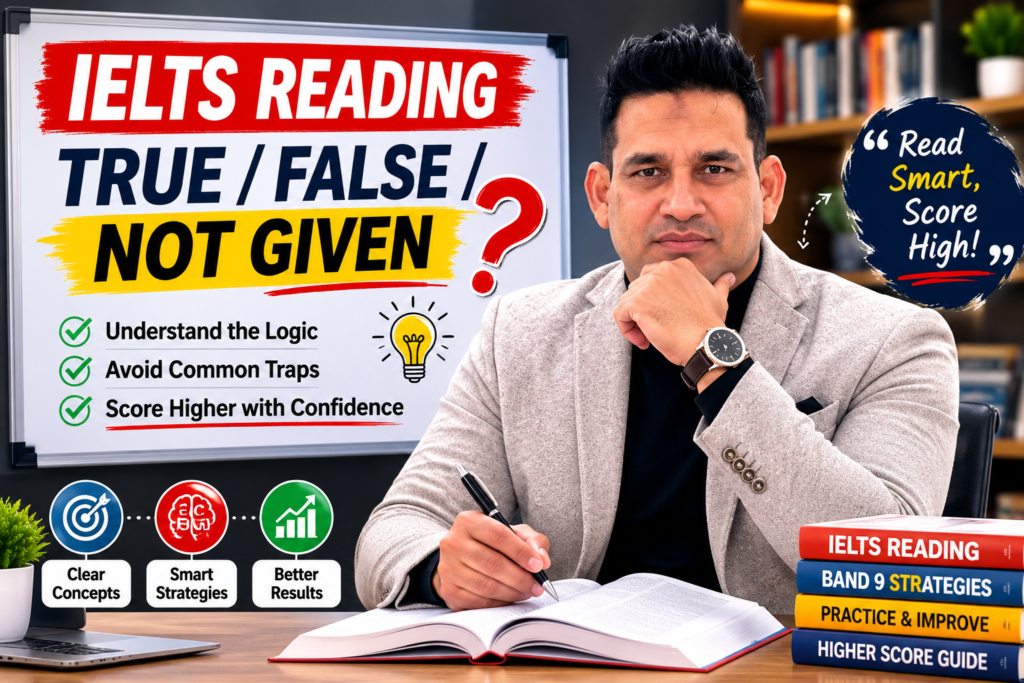
What Are IELTS True False Not Given Questions?
In the IELTS Reading test, you may be given several statements based on information in a reading passage.
Your task is to decide whether each statement is:
- TRUE – the statement agrees with the information in the passage.
- FALSE – the statement contradicts the information in the passage.
- NOT GIVEN – the passage does not provide enough information to determine whether the statement is true or false.
This sounds simple.
But here is where many students lose marks:
They choose False when the information is actually Not Given.
Or they choose True because the statement sounds reasonable in real life, even though the passage never says it.
That is exactly what IELTS test writers want you to do.
The key to success is learning to treat the passage as your entire universe of information.
Do not use your personal knowledge.
Do not make assumptions.
Do not complete the writer’s ideas yourself.
Your answer must come from the text.
official IELTS Reading test guidelines
True vs False vs Not Given: The Golden Rule
Before learning complicated IELTS Reading techniques, memorize these three definitions.
TRUE = The passage agrees.
The statement expresses the same idea as the passage, even if IELTS uses different words through paraphrasing and synonyms.
FALSE = The passage says the opposite.
The passage contains information that directly contradicts the statement.
NOT GIVEN = The passage does not tell you.
The information necessary to prove the statement true or false is missing.
Here is the easiest way to remember it:
TRUE = YES, the passage says it.
FALSE = NO, the passage says the opposite.
NOT GIVEN = WE DON’T KNOW because the passage doesn’t tell us.
This simple distinction is the foundation of the entire IELTS True False Not Given strategy.
The Biggest IELTS Reading Problem: False vs Not Given
If you remember only one thing from this article, remember this:
False means contradiction.
Not Given means missing information.
This difference is responsible for a huge number of mistakes in IELTS Reading True False Not Given questions.
Imagine the passage says:
“Some species of frogs produce skin toxins when threatened.”
Now consider these statements.
Statement 1:
All frog species produce toxins when threatened.
Answer: FALSE
Why?
The passage says some species.
The statement says all species.
The scope has changed, and the statement contradicts the information in the passage.
official IELTS scoring criteria
Statement 2:
Frogs produce more toxins during summer than winter.
Answer: NOT GIVEN
Why?
The passage talks about frogs and toxins.
But it says absolutely nothing about:
- summer,
- winter,
- seasonal changes,
- or the amount of toxins produced in different seasons.
There is no contradiction.
There is simply no information.
Therefore:
NOT GIVEN.
The “Can I Prove It Wrong?” Test
Here is one of the most useful IELTS Reading tips you can use in the exam.
When you are confused between False and Not Given, ask:
“Can I point to a specific sentence in the passage that proves this statement is wrong?”
If YES → FALSE
You have found explicit contradictory evidence.
If NO → NOT GIVEN
You are probably relying on:
- assumptions,
- personal knowledge,
- common sense,
- predictions,
- or information that is not actually in the passage.
This is one of the simplest ways to improve your IELTS Reading accuracy.
Cambridge IELTS official preparation materialshttps://www.cambridgeenglish.org/exams-and-tests/ielts/
True, False and Not Given: Quick Comparison
| Question Type | What Does the Passage Do? | What You Need to Find |
|---|---|---|
| TRUE | Agrees with the statement | Supporting evidence |
| FALSE | Contradicts the statement | Opposite or contradictory evidence |
| NOT GIVEN | Does not provide enough information | No proof either way |
TRUE
The passage supports the statement.
It may use completely different vocabulary because IELTS frequently tests paraphrasing.
FALSE
The passage provides clear evidence against the statement.
You should be able to show exactly why the statement is wrong.
NOT GIVEN
The passage does not give enough information.
You cannot prove the statement true.
You also cannot prove it false.
That is the crucial difference.
Why IELTS Candidates Get True False Not Given Wrong
Many students approach these questions like this:
“Does this statement sound correct?”
That is the wrong question.
IELTS is asking:
“Does the passage prove this statement?”
These are completely different questions.
For example, suppose the passage says:
“The museum was built in 1912 and houses over 500 ancient artifacts.”
The question says:
“The museum is located in London.”
Maybe you know that a famous museum with a similar description is located in London.
It does not matter.
If the passage does not mention London, the answer is:how
NOT GIVEN.
This is one of the most important lessons in IELTS Reading test preparation:
Your real-world knowledge does not count. The passage is the evidence.
4 IELTS Reading Traps in IELTS Reading True False Not Given
IELTS test writers use predictable techniques to make True False Not Given questions difficult.
Understanding these traps can dramatically improve your performance.
Trap 1: Qualifier Words
All vs Some
Always vs Sometimes
Never vs Often
Only vs Many
These tiny words can completely change the meaning of a statement.
Consider:
“Some species of frogs produce skin toxins when threatened.”
Now look at:
“All frog species produce toxins when threatened.”
The difference between some and all is only one word.
But that one word changes the answer to:
FALSE.
Important IELTS qualifiers to watch:
- all
- some
- most
- many
- few
- always
- sometimes
- never
- only
- mainly
- generally
- exclusively
- frequently
- rarely
- must
- may
- might
- could
- definitely
Whenever you see one of these words in an IELTS Reading statement, slow down and check the exact meaning.
Trap 2: The Comparison Trap
Another common IELTS Reading question trap is introducing a comparison that does not exist in the passage.
Suppose the passage says:
“Electric vehicles have experienced significant sales growth in Western Europe.”
Now the statement says:
“Electric vehicles are more popular in Western Europe than in North America.”
Does the passage compare Europe with North America?
No.
It only tells us that electric vehicle sales have increased in Western Europe.
It does not tell us whether they are:
- more popular,
- less popular,
- equally popular,
- or completely different
in North America.
Therefore, the answer is:
NOT GIVEN
Exam tip
If a statement contains words such as:
- more than
- less than
- better than
- faster than
- larger than
- higher than
- lower than
- the most
- the least
look carefully for an actual comparison in the passage.
Two things being mentioned does not automatically mean they are being compared.
Trap 3: Possibility vs Certainty
IELTS frequently tests modal verbs and degrees of certainty.
Compare:
may affect
with:
will definitely affect
These do not mean the same thing.
For example, the passage says:
“Scientists believe that climate change may affect bird migration patterns.”
The statement says:
“Climate change will definitely alter bird migration routes.”
The passage describes a possibility.
The statement describes a certainty.
The statement is therefore too strong and contradicts the level of certainty expressed by the passage.
Answer: FALSE
Pay special attention to:
Possibility
- may
- might
- could
- possibly
Certainty
- will
- definitely
- certainly
- must
A single modal verb can determine your answer.
Trap 4: “True in Real Life” Does Not Mean True in IELTS
This is one of the most dangerous mistakes in the IELTS Reading test.
Imagine the passage says:
“The museum was built in 1912 and houses over 500 ancient artifacts.”
The statement says:
“The museum is located in London.”
You might know the museum.
You might know its location.
You might even be completely certain that the statement is factually correct.
But if the passage does not provide that information, your answer should be:
NOT GIVEN
IELTS Reading is not asking:
“Is this fact true in the real world?”
It is asking:
“Does the passage tell us this?”
That difference can save you several marks.
“The ultimate goal of any solid IELTS Reading True False Not Given strategy is to rely strictly on evidence from the passage rather than intuition.”
How to Answer True False Not Given Questions Step by Step
Now let’s turn the theory into a practical IELTS Reading strategy.
Use this process for every statement.
Step 1: Find the Key Information
Identify the important words in the statement.
Look for:
- names
- dates
- places
- numbers
- unusual nouns
- important verbs
- qualifiers
- comparisons
Do not try to understand every word equally.
Step 2: Locate the Relevant Part of the Passage
Use keywords to find where the topic is discussed.
But remember:
IELTS usually paraphrases the statement.
The passage may not use the exact words from the question.
For example:
launched
may become:
deployed into space
Therefore, search for the idea, not just the exact vocabulary.
Step 3: Compare Meaning, Not Words
Ask:
Does the passage support this idea?
If yes:
TRUE
Ask:
Does the passage clearly say the opposite?
If yes:
FALSE
If neither is possible:
NOT GIVEN
This gives you a simple three-question decision system:
1. Does the text agree? → TRUE
2. Does the text contradict it? → FALSE
3. Does the text provide insufficient information? → NOT GIVEN
IELTS True False Not Given Practice: Worked Examples
The best way to master this question type is through practice.
Let’s apply the strategy to three different topics.
“Knowing how to handle IELTS Reading True False Not Given tasks prevents you from losing easy marks.”
Practice Set 1: Space Exploration
Reading Passage
The James Webb Space Telescope (JWST), launched in December 2021, is the most powerful space observatory ever constructed. Designed primarily to conduct infrared astronomy, JWST can detect celestial objects that are too cold, faint, or distant to be observed by the Hubble Space Telescope.
Unlike Hubble, which orbits Earth at an altitude of approximately 570 kilometers, JWST orbits the Sun at a distance of 1.5 million kilometers from Earth at the second Lagrange point.
Question 1
The James Webb Space Telescope was deployed into space in 2021.
Answer: TRUE
The passage says JWST was “launched in December 2021.”
“Deployed into space” expresses the same basic idea as “launched.”
This is a classic example of IELTS paraphrasing.
Question 2
The Hubble Space Telescope orbits closer to Earth than the James Webb Space Telescope.
Answer: TRUE
The passage states:
- Hubble → approximately 570 km from Earth
- JWST → approximately 1.5 million km from Earth
Therefore, Hubble is much closer to Earth.
The statement agrees with the passage.
TRUE
Question 3
The Hubble Space Telescope was built by European engineers.
Answer: NOT GIVEN
Does the passage tell us who built Hubble?
No.
It tells us about:
- Hubble’s orbit,
- JWST,
- infrared astronomy,
- and the capabilities of the telescopes.
But there is no information about the engineers who constructed Hubble.
Therefore:
NOT GIVEN
Do not use outside knowledge.
Question 4
The James Webb Space Telescope operates in exactly the same orbit as the Hubble Space Telescope.
Answer: FALSE
The passage clearly gives two different orbital arrangements.
Hubble orbits Earth.
JWST orbits the Sun at a much greater distance from Earth.
Therefore, the statement directly contradicts the passage.
FALSE
Practice Set 2: Ancient History and Archaeology
Reading Passage
The Indus Valley Civilization, which flourished between 2600 BCE and 1900 BCE in present-day Pakistan and northwest India, was renowned for its sophisticated urban planning.
Cities such as Harappa and Mohenjo-daro featured grid-pattern streets, elaborate drainage systems, and standardized brick dimensions.
Surprisingly, archaeological excavations have revealed an absence of royal palaces, major military fortifications, or grandiose monuments dedicated to kings, leading scholars to hypothesize that their social structure was surprisingly egalitarian.
Question 5
Harappa and Mohenjo-daro lacked organized street layouts.
Answer: FALSE
The passage says these cities had:
“grid-pattern streets”
A grid pattern is an organized street layout.
The statement says the opposite.
FALSE
Question 6
Scholars have conclusively proven that kings ruled the Indus Valley Civilization.
Answer: FALSE
The passage discusses the absence of:
- royal palaces,
- major military fortifications,
- and monuments dedicated to kings.
It says this evidence led scholars to hypothesize that the society may have been egalitarian.
The statement also uses the word “conclusively.”
The passage does not provide conclusive proof of kings ruling the civilization.
The statement therefore contradicts the passage.
FALSE
Question 7
The decline of Mohenjo-daro was caused by a major severe drought.
Answer: NOT GIVEN
Does the passage explain why Mohenjo-daro declined?
No.
The passage discusses:
- urban planning,
- streets,
- drainage,
- bricks,
- social structure,
- and the absence of royal monuments.
It does not mention drought as a cause of decline.
Therefore:
NOT GIVEN
Practice Set 3: Nutrition and Health
Reading Passage
Dietary fiber, found predominantly in fruits, vegetables, whole grains, and legumes, plays an essential role in digestive health.
Studies demonstrate that soluble fiber absorbs water during digestion, forming a gel-like substance that helps lower blood cholesterol levels and regulate glucose absorption.
Conversely, insoluble fiber adds bulk to stool and promotes the movement of material through the digestive tract.
While most adults fall short of the recommended daily intake of 25 to 30 grams, excessively rapid increases in fiber consumption can lead to temporary abdominal discomfort and bloating.
Question 8
Soluble fiber dissolves in water to form a gel-like material.
Answer: TRUE
The passage says soluble fiber:
“absorbs water during digestion, forming a gel-like substance.”
The statement expresses the same idea.
TRUE
Question 9
Insoluble fiber is more beneficial for human health than soluble fiber.
Answer: NOT GIVEN
The passage explains the different functions of soluble and insoluble fiber.
However, does it compare which one is more beneficial?
No.
The statement introduces a comparison that the passage does not make.
Therefore:
NOT GIVEN
This is the comparison trap.
Question 10
Rapidly increasing daily fiber intake never causes digestive side effects.
Answer: FALSE
The passage explicitly states that rapid increases in fiber consumption:
“can lead to temporary abdominal discomfort and bloating.”
The statement says:
“never causes digestive side effects.”
The two ideas directly contradict each other.
FALSE
The 3-Step IELTS Decision Algorithm
When you are under time pressure, you need something faster than a long explanation.
Use this simple algorithm.
QUESTION
Does the passage support the statement?
↓
YES
TRUE
The information agrees with the passage.
↓
NO
Ask:
Does the passage clearly contradict the statement?
↓
YES
FALSE
The passage gives opposite information.
↓
NO
NOT GIVEN
The passage does not provide enough information.
The Most Important IELTS Reading Rule
Never choose FALSE simply because you cannot find the statement.
This is a major mistake.
Think about it carefully:
“I cannot find evidence”
does not automatically mean:
“The statement is wrong.”
It may simply mean:
“The passage does not tell me.”
And that is:
NOT GIVEN
Similarly, do not choose TRUE because the statement sounds logical.
The passage must support it.
IELTS Reading Keywords You Should Watch
Certain words are especially dangerous in True False Not Given questions.
Quantity
- all
- some
- most
- many
- few
- several
- every
- none
Frequency
- always
- usually
- often
- sometimes
- rarely
- never
Degree
- completely
- partially
- mainly
- significantly
- slightly
- exactly
Comparison
- more
- less
- better
- worse
- faster
- slower
- higher
- lower
- greater
- smaller
- most
- least
Certainty
- definitely
- certainly
- must
- will
Possibility
- may
- might
- could
- possibly
- potentially
These words often determine whether an answer is True, False or Not Given.
Common IELTS Reading Mistakes to Avoid
Mistake 1: Searching for Exact Words
IELTS uses paraphrasing.
The question might say:
deployed
while the passage says:
launched
Do not assume the answer is missing just because the vocabulary is different.
Better strategy:
Search for meaning and synonyms.
Mistake 2: Using Your Own Knowledge
You may know the subject extremely well.
That can actually hurt your score.
Your job is not to answer:
“What do I know about this topic?”
Your job is to answer:
“What does this passage tell me?”
Mistake 3: Confusing Partial Agreement with True
Suppose the passage says:
“Some students prefer online classes.”
The statement says:
“All students prefer online classes.”
The topic is similar.
But the meaning is not the same.
Some ≠ all.
Therefore, the statement is false.
Mistake 4: Treating Missing Information as False
If the passage says nothing about a particular issue, you cannot automatically call it false.
Ask:
Can I prove that the statement is wrong?
If you cannot:
NOT GIVEN
Mistake 5: Ignoring Small Words
Words such as only, never, all, some, may, must, more, less can completely change an answer.
Never rush past them.
How to Improve Your IELTS Reading Score
If you want a higher IELTS Reading band score, do not simply complete hundreds of random questions.
Instead, analyze why you made each mistake.
Create three categories:
TRUE mistakes
Ask:
Did I fail to recognize a paraphrase?
FALSE mistakes
Ask:
Did I miss a contradiction or qualifier?
NOT GIVEN mistakes
Ask:
Did I assume information that wasn’t actually in the passage?
This turns every practice test into a learning opportunity.
A Simple Band 9 Mindset for True False Not Given
High-scoring IELTS candidates do not ask:
“What answer feels right?”
They ask:
“What evidence does the passage give me?”
That is the mindset you need.
Think like a lawyer.
You need evidence.
If the passage supports the claim:
TRUE
If the passage destroys the claim:
FALSE
If there is insufficient evidence:
NOT GIVEN
No guessing.
No assumptions.
No personal opinions.
Just evidence.
IELTS True False Not Given Cheat Sheet
Before your IELTS exam, memorize this:
TRUE
The passage says YES.
FALSE
The passage says NO / the opposite.
NOT GIVEN
The passage does not tell me.
If confused between FALSE and NOT GIVEN:
Ask:
“Can I prove the statement is wrong using the passage?”
YES → FALSE
NO → NOT GIVEN
Final IELTS Reading Strategy
When you face True False Not Given questions in the IELTS Reading test, follow these six rules:
1. Look for paraphrases
Do not search only for identical words. IELTS frequently changes vocabulary while keeping the same meaning.
2. Remember that False means contradiction
Choose FALSE only when the passage clearly provides contradictory information.
3. Remember that Not Given means missing information
Choose NOT GIVEN when the passage does not contain enough evidence to prove or disprove the statement.
4. Watch every qualifier
Pay special attention to:
all, some, most, always, never, only, may, must, more, less, main, traditional, modern.
One word can change the answer.
5. Be careful with comparisons
If the question says something is better, faster, larger, more popular, or more effective than something else, make sure the passage actually makes that comparison.
6. Trust the passage—not your knowledge
Even if a statement is true in real life, it is NOT GIVEN if the passage does not provide the information.
Final Takeaway: Master the Logic, Not the Guessing
The secret to mastering IELTS Reading True False Not Given questions is not memorizing hundreds of vocabulary words.
It is learning to control your logic.
Remember:
TRUE = The passage supports it.
FALSE = The passage contradicts it.
NOT GIVEN = The passage doesn’t tell you.
And when you are stuck between False and Not Given, use the most powerful question:
“Can I prove it wrong from the passage?”
If you can, choose FALSE.
If you cannot, choose NOT GIVEN.
Once this distinction becomes automatic, one of the most difficult IELTS Reading question types becomes much more predictable—and much easier to score well on.
Practice this strategy repeatedly, analyze your mistakes, and train yourself to search for evidence rather than assumptions. That is the path toward a stronger IELTS Reading score and, ultimately, a Band 8 or Band 9 performance.
Related posts:
 IELTS Reading Masterclass :”Why Pakistani Students Fail IELTS Reading (And The 60-Minute System to Hit Band 8+)”
 Stuck at Band 6.5 in IELTS Reading? Here is the Secret Strategy to Hit Band 8.0+
 Generating & Structuring Band 9 Ideas for IELTS Writing Task 2
 How to solve matching headings in ielts reading: The Ultimate Masterclass