
If you regularly lose marks in IELTS Reading because you cannot decide which paragraph contains the required information, you are not alone.
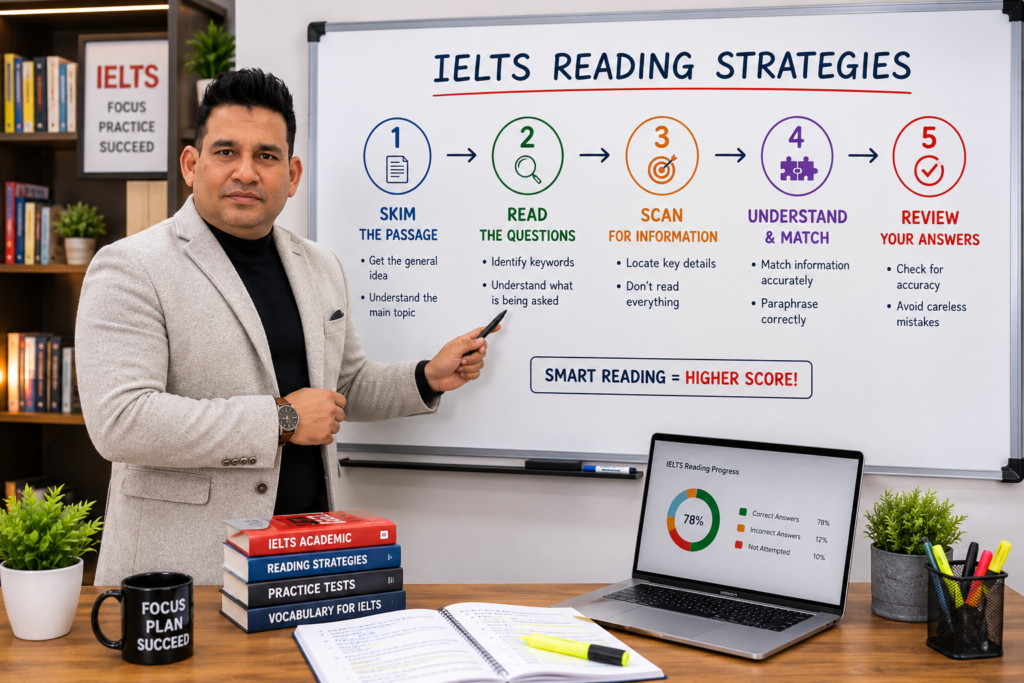
Matching Information questions are one of the IELTS Reading question types that can confuse even students with good English vocabulary. You may understand the passage perfectly but still choose the wrong paragraph because IELTS does not usually repeat the wording from the question in the passage.
The test often hides the answer behind paraphrasing, synonyms, examples, explanations, comparisons, causes, effects, and changes in sentence structure.
The good news is that Matching Information questions are not solved by reading every paragraph again and again.
They are solved by using a systematic method.
In this complete guide, you will learn:
- What Matching Information questions are
- How to identify the correct paragraph
- Why Pakistani students struggle with this question type
- How to recognize paraphrases
- How to scan the passage efficiently
- How to identify keywords and information types
- How to avoid common IELTS Reading traps
- How to deal with difficult vocabulary
- How to improve speed and accuracy
- How Band 8 and Band 9 students approach these questions
- How to practise Matching Information effectively
By the end of this article, you will have a practical strategy that you can apply to almost any IELTS Reading passage.
What Are Matching Information Questions in IELTS Reading?
In a Matching Information question, you are given several statements and asked to identify which paragraph or section contains the information described in each statement.
For example, you may see:
Which paragraph contains the following information?
Then you might receive statements such as:
- A reason why a particular development happened
- An example of an unusual result
- A description of a scientific discovery
- A comparison between two approaches
- An explanation of a problem
- A reference to a historical event
The passage may contain paragraphs labelled A, B, C, D, E, F, G and H.
Your task is to determine which paragraph contains the specific information described in each statement.
The important point is this:
You are not matching words. You are matching meaning.
This is the foundation of the entire strategy.
For official practice materials and test format guidelines, students can refer to the Official IELTS Website.
Matching Information vs Matching Headings
Many IELTS students confuse Matching Information with Matching Headings.
They are different.
Matching Headings
Matching Headings focuses mainly on the main idea or central theme of a paragraph.
You ask:
What is this paragraph mainly about?
Matching Information
Matching Information focuses on a specific piece of information.
You ask:
Where does the writer mention this particular fact, reason, example, explanation, comparison, or description?
For example, a paragraph may mainly discuss the development of renewable energy but contain one sentence explaining why an early project failed.
If the question asks for the reason for the failure, you need to locate that specific information—not simply choose the paragraph whose overall topic is renewable energy.
This distinction is one of the most important IELTS Reading techniques to master.
Explore additional reading practice tools and sample questions on the British Council IELTS Preparation Hub.
Why Are Matching Information Questions Difficult?
There are several reasons students struggle with this question type.
1. IELTS Uses Paraphrasing
The question might say:
a reason for the decline in demand
while the passage says:
consumers gradually stopped purchasing the product because of rising costs.
The words are different, but the meaning is connected.
Students who search only for exact vocabulary may miss the answer.
2. Answers May Not Appear in Order
In many IELTS Reading question types, students expect answers to follow the order of the passage.
Matching Information can be different.
The first statement may be answered in paragraph F, while the second answer may be in paragraph B.
Therefore, blindly reading from Paragraph A to Paragraph H for every question can waste valuable time.
3. Several Paragraphs May Discuss the Same Topic
A passage about climate change might mention:
- causes
- effects
- government policies
- scientific research
- economic consequences
- historical developments
Several paragraphs can therefore contain similar vocabulary.
The challenge is identifying the exact information requested.
4. Distractors Look Attractive
IELTS writers may deliberately include related information in another paragraph.
You may see the same topic, person, place, or concept in two paragraphs.
But only one paragraph contains the specific information in the question.
That is why finding a familiar keyword is not enough.
Formal vs Informal English for IELTS Academic Writing
Common Problems Faced by Pakistani IELTS Students
Pakistani students often have strong academic knowledge but experience particular difficulties in IELTS Reading.
Understanding these difficulties can make preparation more effective.
Problem 1: Translating Every Sentence into Urdu
Many students read English sentence by sentence and mentally translate everything into Urdu.
This makes reading extremely slow.
Solution
Train yourself to understand the meaning directly in English.
You do not need to translate:
The researchers subsequently abandoned the project due to financial constraints.
into Urdu before understanding it.
Instead, recognize the structure:
researchers + abandoned project + because of money problems
That is enough to locate the information.
Problem 2: Searching for Exact Words
A student sees the phrase:
environmental damage
and searches for exactly those words.
But the passage might say:
ecological harm
or:
deterioration of natural habitats.
If you depend on exact wording, you may conclude that the information is not present.
Solution
Build a paraphrase mindset.
Whenever you see an important word, immediately think of possible alternatives.
For example:
| Question | Possible Passage Paraphrase |
| increase | rise, growth, expansion |
| decrease | decline, reduction, fall |
| important | significant, crucial, major |
| reason | cause, explanation, factor |
| problem | issue, difficulty, challenge |
| result | outcome, consequence, effect |
| change | transformation, shift, modification |
| old | ancient, previous, former |
| new | recent, modern, emerging |
You do not need to memorize thousands of synonyms.
You need to recognize relationships between words and ideas.
Problem 3: Reading the Entire Passage Again and Again
Some students read the passage completely, then read it again while answering questions.
This consumes too much time.
IELTS Reading gives you a limited amount of time, so efficient reading is essential.
Solution
Use targeted scanning.
Read the questions first.
Identify the important information.
Then scan the passage for possible locations.
Once you find a promising paragraph, read the relevant sentences carefully.
Problem 4: Choosing an Answer Because of One Keyword
Suppose the question mentions:
a significant discovery
and Paragraph C contains the word “discovery.”
You immediately choose C.
That can be a trap.
The paragraph may discuss an unrelated discovery.
Solution
Use the meaning verification rule:
Never choose a paragraph because one word matches. Choose it because the complete idea matches.
The Golden Rule: Match Meaning, Not Words
This is the most important rule for Matching Information questions.
Imagine the question says:
a reason why researchers changed their original approach
The passage might say:
After several unsuccessful experiments, the scientists decided to adopt a completely different method.
The vocabulary is different.
But the meaning is clear:
- researchers = scientists
- changed = adopted a different method
- original approach = previous method
- reason = unsuccessful experiments
This is a successful match.
Remember:
IELTS tests your ability to recognize meaning, not your ability to find identical words.
Step-by-Step Method to Solve Matching Information Questions
Now let us build a practical Band 9 strategy.
Step 1: Read the Instructions Carefully
Before doing anything else, check the instructions.
Look for information such as:
- Can a paragraph be used more than once?
- Are there more options than questions?
- Do all paragraphs need to be used?
Never assume the rules.
The instructions determine how you should approach the task.
Step 2: Read the Statements Before Searching
Do not immediately read the whole passage.
Start with the statements.
For example:
A reason why the project was unsuccessful
Underline mentally:
reason — project — unsuccessful
Then identify what type of information you need.
Here, the key information type is:
cause/reason
This dramatically reduces your search area.
Step 3: Identify the Information Type
Every Matching Information statement usually contains a clue about what you are looking for.
Common information types include:
Cause or Reason
Look for:
- because
- due to
- resulted from
- caused by
- as a result of
- owing to
Example
Look for:
- for example
- such as
- one case
- an instance
- including
Comparison
Look for:
- unlike
- compared with
- whereas
- similar to
- in contrast
Result or Consequence
Look for:
- therefore
- consequently
- resulted in
- led to
- caused
Description
Look for sentences explaining:
- appearance
- characteristics
- structure
- behavior
- function
Identifying the information type gives your brain a search direction.
Step 4: Create a Keyword Cluster
Do not underline every word.
Choose two or three strong concepts.
For:
a reason why young people abandoned traditional forms of entertainment
your keyword cluster could be:
young people + abandoned + traditional entertainment
Then predict possible paraphrases.
Young people
- teenagers
- adolescents
- younger generations
- youth
Abandoned
- stopped using
- moved away from
- rejected
- gave up
Traditional entertainment
- conventional leisure activities
- older forms of recreation
- traditional pastimes
Now you are searching for ideas rather than exact vocabulary.
Step 5: Predict Paraphrases Before Scanning
This is an advanced but extremely useful technique.
Before looking at the passage, ask:
How might the writer express this idea differently?
For example:
Question:
A reason for the decline in newspaper readership.
Possible passage language:
- fewer people reading newspapers
- falling circulation
- declining demand for printed news
- readers moving to digital platforms
- newspapers losing their audience
When you begin predicting paraphrases, Matching Information becomes much faster.
Step 6: Scan the Passage Strategically
Now scan the paragraphs.
Look for anchors.
An anchor is a feature that is relatively easy to locate, such as:
- a person’s name
- a place
- a date
- a number
- a scientific term
- a capitalized name
- an unusual technical word
For example, if the statement refers to:
Professor Ahmed’s explanation of the phenomenon
search for the name first.
Once you locate the relevant paragraph, examine the surrounding sentences.
Step 7: Verify the Information
Finding a promising paragraph is not the end.
Read the relevant sentence or sentences carefully.
Ask:
Does the paragraph contain the exact idea?
Not:
Does this paragraph mention the same topic?
But:
Does this paragraph contain the information described in the statement?
This distinction prevents many mistakes.
The Anchor Rule
One of the fastest ways to improve your IELTS Reading score is to learn how to identify anchors.
An anchor is a distinctive word or concept that helps you locate the relevant part of the passage.
Strong anchors include:
- names
- years
- unusual nouns
- technical terms
- places
- percentages
- measurements
- organizations
Weak anchors include:
- important
- people
- things
- problem
- change
- study
Why?
Because weak words appear throughout the passage.
Strong anchors are much easier to locate.
The Two-Sentence Verification Rule
Once you locate a possible answer, read at least the relevant sentence and its surrounding context.
Why?
Because a single sentence may not contain the complete relationship.
For example:
The experiment produced promising results. However, the researchers later discovered that the sample had been contaminated.
If the question asks for a reason the results could not be trusted, the answer is not simply “promising results.”
The important information is the contamination.
Context matters.
The Three-Part Evidence Test
Before selecting an answer, ask:
1. Topic
Is the paragraph discussing the same subject?
2. Relationship
Does it describe the same relationship—such as cause, comparison, example, or result?
3. Specificity
Does it contain the exact information requested?
If all three are satisfied, your answer is much more likely to be correct.
How to Identify Cause-and-Effect Information
Cause-and-effect statements are common.
Suppose the question says:
a reason for the decline in agricultural production
You need to find the cause, not simply the decline.
Look for structures such as:
- because
- because of
- due to
- resulted from
- was caused by
- led to
- contributed to
Also watch for less obvious structures:
Poor rainfall meant that farmers were unable to maintain normal production.
Here:
poor rainfall = cause
lower production = effect
Understanding relationships is more important than memorizing linking words.
How to Recognize Comparisons and Contrasts
A statement may ask for:
a comparison between two approaches
Look for:
- whereas
- while
- unlike
- in contrast
- compared with
- on the other hand
- similarly
- both
But sometimes the comparison is indirect.
For example:
The first method relied heavily on human observation, while the newer system used automated sensors.
The passage may never use the word “comparison.”
Yet the comparison is obvious.
Examples vs General Statements
This is another common IELTS trap.
Suppose a paragraph says:
Many cities have adopted bicycle-sharing systems. Amsterdam provides one of the best-known examples.
If the question asks for:
an example of a city using bicycle-sharing
the second sentence is relevant.
If the question asks for:
a general statement about cities adopting bicycle-sharing
the first sentence may be more relevant.
Always distinguish between:
general claim
and
specific example
Names, Dates and Numbers: Use Them as Anchors
Proper nouns and numbers are powerful search tools.
Suppose a statement mentions:
research conducted in 2018
Do not read every paragraph looking for the entire sentence.
Scan visually for:
2018
Similarly, if the statement mentions a scientist, organization, city, or unusual technical term, use that as your anchor.
However, remember:
Finding the anchor does not automatically mean you have found the answer.
Always verify the meaning.
What If You Do Not Know a Word?
Do not panic.
You can often answer the question without understanding every word.
For example:
The researchers observed a substantial decline in biodiversity following the introduction of the invasive species.
Even if you do not know “biodiversity,” you may understand:
- researchers observed something
- there was a decline
- an invasive species was introduced
If the question asks for the cause of the decline, you can identify:
introduction of the invasive species
IELTS Reading tests comprehension, not dictionary knowledge.
Stop Translating Everything
For many Pakistani students, reducing mental translation is one of the fastest ways to improve reading speed.
Instead of translating every sentence, focus on:
Who? What? Why? How? Result?
For example:
Following a prolonged period of drought, several agricultural communities were forced to abandon traditional farming practices.
You do not need to translate every word.
Understand:
drought → farming communities → traditional practices abandoned
That is enough for many questions.
Vocabulary Strategy for Pakistani IELTS Students
Do not study vocabulary only as isolated words.
Study vocabulary in families and relationships.
For example:
Increase
- rise
- grow
- expand
- climb
- surge
- increase significantly
Decrease
- decline
- fall
- reduce
- drop
- decrease
- diminish
Cause
- reason
- factor
- driver
- explanation
- source
Result
- outcome
- consequence
- effect
- impact
This improves your ability to recognize paraphrasing.
Common Traps in Matching Information Questions
Trap 1: Same Keyword, Different Meaning
A paragraph contains the same keyword but discusses something else.
Solution
Check the entire idea.
Trap 2: Same Topic, Wrong Information
Two paragraphs discuss the same topic.
Only one contains the required detail.
Solution
Identify the information type.
Trap 3: Correct Person, Wrong Detail
The question mentions a scientist.
You find the scientist’s name.
But the paragraph discusses a different statement made by that scientist.
Solution
Read the surrounding context.
Trap 4: Cause vs Result
You find the result but the question asks for the cause.
Solution
Identify the direction of the relationship.
Cause → Effect
Trap 5: Example vs Explanation
The passage contains an example related to the topic, but the question asks for an explanation.
Solution
Ask what the question specifically requests.
What If Two Paragraphs Look Correct?
This is one of the most common situations in the IELTS Reading test.
Suppose Paragraph B and Paragraph E both seem relevant.
Do not guess.
Use the information-type filter.
Ask:
- Which paragraph contains the exact topic?
- Which paragraph contains the required relationship?
- Which paragraph contains the specific detail?
For example:
Question:
a reason why the company changed its policy
Paragraph B mentions the policy.
Paragraph E explains why it was changed.
The correct answer is E.
Remember:
Topic similarity is not enough.
Do Matching Information Answers Come in Order?
Do not assume that they do.
The safest approach is to treat each statement as an independent search task unless the instructions or question structure clearly indicates otherwise.
This means you should be comfortable moving between paragraphs.
For example:
- Question 1 → Paragraph F
- Question 2 → Paragraph C
- Question 3 → Paragraph H
- Question 4 → Paragraph B
This is normal.
Do not waste time expecting a sequence.
How to Save Time in IELTS Reading
Time management is essential for a high IELTS Reading score.
A practical strategy is:
First: Understand the task
Know exactly what information you are searching for.
Second: Scan
Use keywords, anchors and predicted paraphrases.
Third: Verify
Read the relevant context.
Fourth: Move on
Do not spend several minutes defending one uncertain answer.
If you cannot decide between two options, mark your best choice and continue.
You can return later if time allows.
What Band 9 Students Do Differently
Band 9 performance is not simply about knowing more vocabulary.
High-level candidates tend to:
- recognize paraphrases quickly
- identify information types
- scan strategically
- avoid unnecessary rereading
- understand relationships between ideas
- distinguish main ideas from details
- recognize distractors
- use context to confirm answers
- manage time carefully
- learn from repeated mistakes
The goal is not to read faster by reading carelessly.
The goal is to read selectively.
Advanced Technique: Predict the Sentence
Before scanning, imagine what the answer sentence might look like.
Question:
a reason why the experiment failed
Predict:
The experiment failed because…
or:
Researchers discovered that…
or:
One factor responsible for the failure was…
Then scan for ideas matching that structure.
This creates a mental search template.
Advanced Technique: Separate Searching from Judging
Do not make a final decision while you are still searching.
First:
Find possible locations.
Then:
Compare them.
Finally:
Choose the strongest evidence.
This prevents the common problem of seeing one familiar word and immediately selecting an answer.
Advanced Technique: Track Relationships
High-level IELTS Reading requires more than vocabulary recognition.
Track relationships such as:
cause → effect
problem → solution
old → new
theory → evidence
claim → example
general → specific
advantage → disadvantage
similarity → difference
If you understand the relationship, you can often identify the answer even when the vocabulary is unfamiliar.
The Five-Question Self-Check
Before confirming your answer, ask:
1. What information am I looking for?
Example, reason, comparison, result, description?
2. What are the strongest keywords?
Which words or concepts can help me search?
3. What paraphrases might appear?
How could the writer express the same idea differently?
4. Where is the evidence?
Which sentence actually supports my answer?
5. Am I choosing it because of meaning or because of one word?
If the answer is based only on one matching word, check again.
A 30-Day IELTS Reading Matching Information Practice Plan
If you want to improve systematically, practise in stages.
Days 1–7: Learn the Question Type
Study:
- instructions
- information types
- paraphrasing
- scanning
- anchors
Do not focus heavily on speed yet.
Focus on understanding why an answer is correct.
Days 8–14: Practise Paraphrasing
Take IELTS statements and identify:
- keywords
- synonyms
- grammatical changes
- alternative expressions
Create your own paraphrase list.
Days 15–21: Practise Timed Questions
Set a time limit.
Try to locate information without reading the entire passage repeatedly.
Record your accuracy.
Days 22–30: Full Reading Practice
Complete full IELTS Reading tests.
After each test, analyze every mistake.
Do not simply check the correct answer.
Ask:
Why did I choose the wrong paragraph?
That question is more valuable.
How to Analyze Your IELTS Reading Mistakes
Create an error log.
Use categories such as:
Vocabulary Error
You did not understand the paraphrase.
Scanning Error
You failed to locate the relevant information.
Interpretation Error
You found the correct paragraph but misunderstood the idea.
Distractor Error
You selected a paragraph because it contained familiar vocabulary.
Time Error
You spent too long on one question.
Attention Error
You misunderstood the instructions.
This transforms mistakes into a personalized study plan.
The Most Important IELTS Reading Matching Information Tips
If you remember only a few strategies, remember these:
Tip 1: Match meaning, not words.
IELTS frequently uses paraphrasing.
Tip 2: Identify the information type.
Know whether you need a reason, example, comparison, result, or description.
Tip 3: Use strong keywords.
Names, numbers and unusual terms are excellent anchors.
Tip 4: Predict paraphrases.
Think about how the writer might express the idea differently.
Tip 5: Verify the complete meaning.
Never select an answer because of one familiar word.
Tip 6: Do not translate everything.
Focus on meaning and relationships.
Tip 7: Do not assume answers are sequential.
Treat each statement strategically.
Tip 8: Learn from mistakes.
Your error patterns reveal what you need to improve.
IELTS Reading Matching Information: Quick Strategy
Here is the complete process in a simple formula:
Read the statement → identify information type → select keywords → predict paraphrases → scan paragraphs → find an anchor → read context → verify meaning → choose the paragraph.
You can memorize this sequence and practise it until it becomes automatic.
Frequently Asked Questions About Matching Information in IELTS Reading
What is Matching Information in IELTS Reading?
Matching Information is an IELTS Reading question type where you identify the paragraph or section containing specific information described in a statement.
The information may be a reason, example, explanation, comparison, description, result, or other specific detail.
How can I improve Matching Information questions in IELTS?
Improve by practising paraphrasing, scanning, keyword identification, information-type recognition and context verification.
Do not rely on exact word matching.
Are Matching Information answers in order?
You should not assume that they are.
Each statement may correspond to a different paragraph.
Can I use the same paragraph more than once?
This depends on the instructions for the particular question set.
Always read the instructions carefully before answering.
Should I read the whole IELTS Reading passage first?
You can read strategically rather than trying to understand every sentence in detail before looking at the questions.
For Matching Information, identifying the statements and their information types first can make scanning more efficient.
Why do I lose marks even though I understand the passage?
You may be matching keywords instead of meaning.
You may also be confusing the main topic of a paragraph with the specific information requested by the question.
Is vocabulary the most important skill for Matching Information?
Vocabulary is important, but it is not the only skill.
You also need paraphrase recognition, scanning, logical relationships, contextual understanding and time management.
Final Band 9 Strategy for Matching Information Questions
Matching Information questions can initially appear difficult because IELTS deliberately hides information behind paraphrasing and changes in sentence structure.
But once you stop treating them as a vocabulary-matching exercise, they become much more manageable.
Your objective is not to find the sentence that looks most similar to the question.
Your objective is to find the paragraph that contains the same information and relationship.
Remember the complete strategy:
Understand the question.
Identify the information type.
Choose strong keywords.
Predict paraphrases.
Scan strategically.
Use anchors.
Read the surrounding context.
Verify the meaning.
Avoid distractors.
Manage your time.
For Pakistani IELTS students, one of the biggest improvements often comes from changing the way you read. Stop translating every sentence. Stop searching for identical words. Stop choosing answers because a paragraph contains a familiar keyword.
Instead, train yourself to recognize ideas.
When you see:
a reason for a decline
think:
cause + decrease
When you see:
an example of a successful approach
think:
specific case + positive result
When you see:
a comparison between two methods
think:
method A + method B + similarity/difference
This is how strong IELTS readers think.
Your Golden Rule
Locate the idea, not the word.
Verify the evidence, not the feeling.
Manage your time, not your anxiety.
With consistent practice, careful error analysis and the right strategy, Matching Information questions can become one of the most manageable parts of your IELTS Reading test.
Do not aim simply to finish the passage.
Aim to understand where information lives, how it is paraphrased, and why the evidence supports your answer.
That is the mindset that can move your IELTS Reading performance toward Band 9.
This version is structured for on-page SEO + readability + search intent, with the primary keyword naturally reinforced through headings, FAQs, semantic keywords, and practical sections rather than keyword stuffing.
Related posts:
 IELTS Reading Masterclass :”Why Pakistani Students Fail IELTS Reading (And The 60-Minute System to Hit Band 8+)”
 Stuck at Band 6.5 in IELTS Reading? Here is the Secret Strategy to Hit Band 8.0+
 How to solve matching headings in ielts reading: The Ultimate Masterclass
 Boost your IELTS score with 200 essential Band 9 academic words, complete with Urdu translation, usage tips, and practice examples.