
How to Solve matching headings in ielts reading
Mastering How to Solve matching headings in ielts reading is essential if you want to push your overall score to Band 8 or 9. Without a reliable strategy, candidates often waste precious minutes second-guessing their choices. By applying a structured framework, you can tackle these tricky tasks with total confidence.
📌 Quick Navigation:
- 🎯 The 6-Step Golden Blueprint
- ⚠️ Top 10 Distractor Traps Explained
- 📝 Full Worked Case Studies & Answers
- 📥 Download Free Printable Summary Checklist

LECTURE OVERVIEW & OBJECTIVES
What You Will Master Today and will know How To Solve Matiching Headings in ielts Reading
By the end of this comprehensive lecture manual, you will be able to:
- Deconstruct paragraph architecture to instantly identify the Topic Sentence and Main Idea versus supporting details.
- Neutralize the 5 major types of distractor headings engineered by Cambridge test writers.
- Deploy the 6-Step Golden Blueprint to systematically eliminate wrong choices without reading every single word of the passage.
- Identify lexical chains, synonym maps, and signpost transitions that link paragraph content directly to correct headings.
- Execute time-saving strategies that allow you to complete Matching Headings questions in under 1.5 minutes per paragraph.
SECTION 1: UNDERSTANDING THE “LIST OF HEADINGS” CHALLENGE
1.1 Why Is “List of Headings” Considered the Hardest Question Type?
Transforming this intimidating task into an easy win comes down to learning How to Solve matching headings in ielts reading through structural analysis rather than desperate word-matching.
The “Matching List of Headings” question type is consistently ranked by IELTS candidates and examiners as the single most challenging task in the Reading module. Understanding why it is difficult is your very first step toward mastering it. It must be practiced multiple time and know Master how to solve matching headings in ielts reading
1. Global vs. Local Understanding
- Most IELTS reading question types (such as Multiple Choice, Sentence Completion, or True/False/Not Given) test local comprehension. They require you to scan for a specific keyword or fact in a single sentence.
- “Matching Headings,” however, tests global comprehension. It demands that you grasp the overall purpose, overarching theme, or central argument of an entire paragraph.
2. The Keyword Trap (Deliberate Cambridge Trap Engineering)
Test writers deliberately plant exact keywords from the passage into the incorrect headings. If you simply match words without understanding the underlying context, you will fall into a trap.
⚠️ CRITICAL RULE: The correct heading almost always uses synonyms, abstract summaries, or paraphrased concepts rather than matching exact vocabulary from the text.
3. Cognitive Overload and Time Exhaustion
Because “List of Headings” questions usually appear at the very beginning of a passage (before the text itself), candidates often spend 10–12 minutes on this single task. This triggers panic, mental fatigue, and catastrophic time management for the remaining questions.
1.2 Myth-Busting: Debunking Popular IELTS Reading Myths
Before we look at the core strategy, we must dispel dangerous myths floating around internet forums and low-quality test-prep channels.
| Myth | The Dangerous Reality | The Masterclass Strategy |
| Myth #1: “Just read the first and last sentence of every paragraph.” | FAIL: Cambridge test writers know this trick! In over 40% of academic paragraphs, the main idea is in the middle or built gradually. | FACT: Read structurally. Look for topic sentences, but scan the middle section for transition shifts (e.g., However, On the other hand). |
| Myth #2: “Match exact keywords from the heading to the text.” | FAIL: Exact keywords are usually planted as distractor traps in wrong choices! | FACT: Match meaning and concepts, not exact words. Look for abstract summaries and paraphrases. |
| Myth #3: “Read the whole passage first before looking at headings.” | FAIL: You will run out of time! Reading 800+ words without a specific goal wastes precious mental energy. | FACT: Analyze the list of headings first, annotate key concepts, then tackle paragraphs systematically one by one. |
SECTION 2: ANATOMY OF AN ACADEMIC PARAGRAPH
To master heading placement, you must understand how professional academic writers build paragraphs. A standard paragraph is an architectural unit designed to communicate one single central idea.
Before diving into the core blueprint of How to Solve matching headings in ielts reading, you must first understand how professional academic writers construct their paragraphs. Recognizing how topic sentences function will instantly save you time on test day.
2.1 Topic Sentence Variations :
If you want to know how to Solve matching headings in ielts reading you must know The Topic Sentence contains the core message of the paragraph. However, its position varies depending on the author’s stylistic purpose:
Type A: Deductive Pattern (Topic Sentence at Start — ~60% Frequency)
The paragraph starts with the core assertion, followed by supporting evidence.
- Example: “The rapid decline of urban bee populations poses a severe threat to global food security.” (Topic Sentence)Following this line, the author provides agricultural statistics, crop dependency figures, and expert quotes.
Type B: Inductive Pattern (Topic Sentence at End — ~25% Frequency)
The paragraph builds evidence first, culminating in a synthesis or conclusion at the end.
- Example: The paragraph discusses rising temperatures, melting ice caps, shifted migratory patterns, and unusual weather extremes. It concludes with: “Collectively, these phenomena signal an unprecedented acceleration of global climate destabilization.” (Topic Sentence)
Type C: Pivot Pattern (Topic Sentence in the Middle — ~15% Frequency)
The paragraph begins with a traditional view or background, shifts direction with a signpost word (However, Yet, Nevertheless), and delivers the main point.
- Example: “For decades, scientists believed that deep-sea ecosystems relied entirely on solar energy captured via surface photosynthesis.” (Background)“However, the discovery of hydrothermal vent communities revealed an entirely independent biological framework powered by chemosynthesis.” (Topic Sentence)
2.2 Distinguishing the Main Idea from Supporting Details
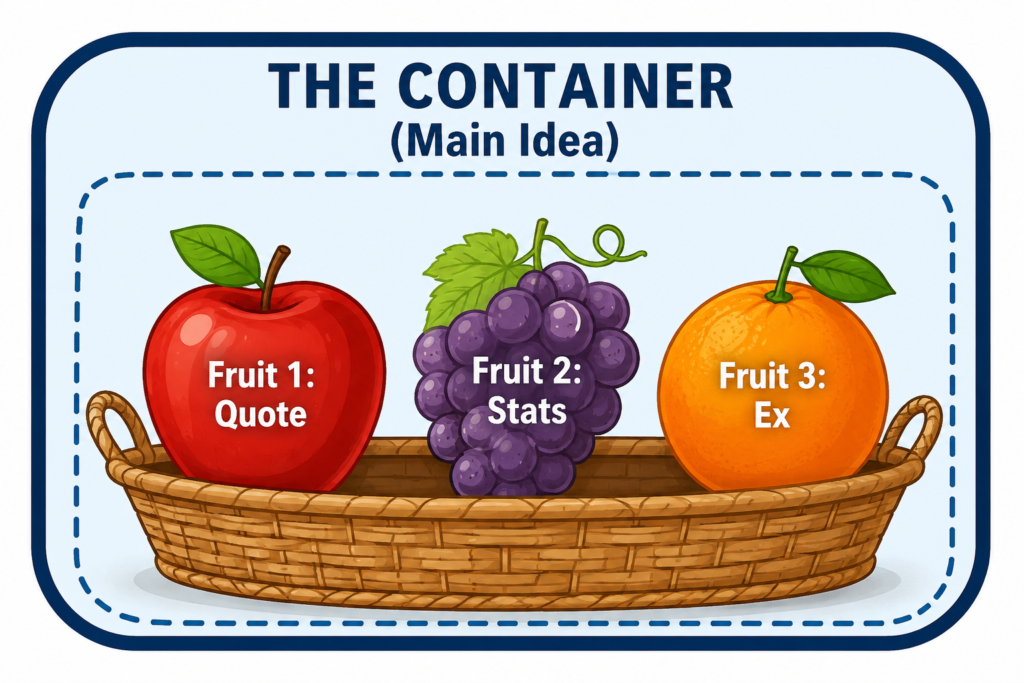
The fundamental skill required for matching headings is separating The Container (Main Idea) from The Contents (Supporting Details).
⚡ GOLDEN RULE: A heading must cover the entire container, not just one single piece of fruit inside it!
If a heading describes only the London Congestion Charge in a paragraph about broader urban transport solutions, it is too specific and therefore incorrect.
SECTION 3: ANATOMY OF HEADINGS AND DISTRACTORS
Cambridge test creators do not construct incorrect headings at random. They design them according to precise distractor patterns. Recognizing these patterns allows you to reject wrong answers in seconds.
3.1 Deep Dive into Distractor Mechanics
Let’s look at how a single paragraph can generate multiple distractor headings.
📝 Sample Short Paragraph:
“In recent years, marine biologists have noted a drastic reduction in North Atlantic cod stocks. While historical overfishing laid the groundwork for this collapse, recent oceanographic data points to rising water temperatures as the primary driver delaying population recovery. Thermal stress alters plankton availability, directly starving juvenile cod before they reach reproductive maturity.”
🔍 Heading Evaluation & Trap Analysis:
- Heading A: The Impact of Ocean Warming on North Atlantic Cod Recovery
- Status: ✅ CORRECT
- Reason: Captures the core focus (warming waters hindering cod recovery) without getting bogged down in minor details.
- Heading B: How Thermal Stress Affects Juvenile Plankton Supply
- Status: ❌ INCORRECT (The Detail Trap)
- Reason: Plankton is mentioned, but only as a supporting detail explaining why cod are dying.
- Heading C: Global Decline of Marine Species
- Status: ❌ INCORRECT (The Over-General Trap)
- Reason: The paragraph is specifically about North Atlantic cod, not global marine species as a whole.
- Heading D: The History of Overfishing in the North Atlantic
- Status: ❌ INCORRECT (The False Focus Trap)
- Reason: Overfishing is mentioned as background (“laid the groundwork”), but the paragraph’s primary focus is current water temperature effects.
Formal vs. Informal English from an IELTS Perspective : Master Class
Official Practice and Format Insights: IELTS IDP Matching Headings Strategies
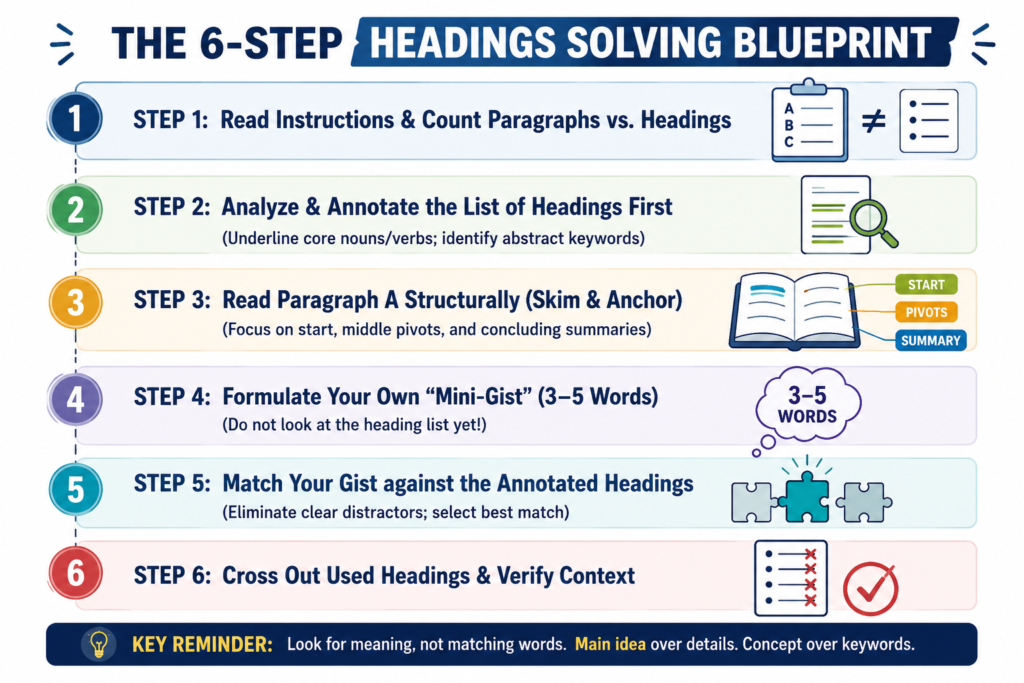
SECTION 4: THE 6-STEP GOLDEN BLUEPRINT
Follow this systematic, repeatable framework to eliminate guesswork and reach the correct answers efficiently every single time.
The following 6-step blueprint outlines the exact tactical sequence you need for How to Solve matching headings in ielts reading systematically and without panic.
4.1 Detailed Breakdown of Each Step
Step 1: Read Instructions & Note the Structure
Always check if an example heading is already provided. If Paragraph A is solved as an example (e.g., Paragraph A = iii), immediately cross out heading iii from your list and cross out Paragraph A! Never re-read an example paragraph.
Step 2: Analyze and Annotate the List of Headings
Do not just passively read the list of headings. Actively analyze them by breaking each heading into two distinct parts:
- The Topic (What): The main subject.
- The Qualifier/Focus (So What?): What specific aspect of the topic is being highlighted?
- Underline Core Concepts: Focus on abstract nouns (causes, solutions, effects, obstacles, history, future, comparisons, debate, financial impact).
- Identify Structural Clues:
- Words like “Reasons for…” mean the paragraph will list multiple causes (Why…).
- Words like “An account of…” imply a narrative or chronological sequence.
- Words like “The link between X and Y” require both X and Y to be present in the text.
Step 3: Read Paragraph A Structurally
Do not read every word with equal intensity. Skim for structure:
- Read sentences 1 and 2 carefully.
- Scan the middle section for transition signals:
- Contrasts: However, Yet, On the other hand, Nevertheless, Despite.
- Causes/Effects: As a result, Consequently, Therefore, Leading to.
- Additions: Furthermore, In addition, Moreover.
- Read the final sentence carefully to see if a conclusion or synthesis is drawn.
Step 4: Formulate Your Own “Mini-Gist” (3 to 5 Words)
Before looking at the option list, pause for 3 seconds and ask yourself:
“If I had to tell a friend what this paragraph is about in 5 words, what would I say?”
Write a tiny margin note in your test booklet (e.g., “Why solar energy failed in Europe” or “Steps to build a wooden canoe”).
Step 5: Match Your Mini-Gist Against the Headings
Compare your independent mini-gist with the list of headings.
- Look for synonym matches, not word-for-word duplicates.
- If two headings seem plausible, put both beside the paragraph (e.g., Paragraph B = ii or vii?) and move to the next paragraph. Returning later with fewer unused headings makes the final choice obvious.
Step 6: Cross Out Used Headings and Verify
Once you settle on a heading, cross it off your master list cleanly. This reduces visual clutter and prevents cognitive fatigue as you move through the remaining paragraphs.
Official Preparation Resources: British Council IELTS Academic Reading Preparation
SECTION 5: ADVANCED LEXICAL & PARAPHRASING MASTERY
Matching Headings relies heavily on lexical equivalencies. Cambridge test writers construct headings by converting concrete textual ideas into abstract summary terms.
5.1 Signpost Transitions and Their Meaning
Transition words reveal the logic of a paragraph. Recognizing them helps you locate the topic sentence instantly.
| Contrast / Pivot | However, Yet, Nevertheless, On the contrary, Despite, In spite of | The author is rejecting a previous idea and introducing the true main topic. |
| Cause & Effect | Consequently, As a result, Thus, Therefore, Stemming from | The paragraph focuses on consequences, impacts, or historical results. |
| Illustration / Detail | For instance, To illustrate, Specifically, Case in point | Signals supporting details. DO NOT base your heading on these sentences! |
| Synthesis / Conclusion | Ultimately, In summary, Broadly speaking, Overall, In short | The main takeaway or summary statement is being delivered right here. |
SECTION 6: WORKED CASE STUDIES (FULL WALKTHROUGH)
Let’s apply our strategy to full-scale practice passages. We will work through every paragraph step-by-step, showing how to select the correct heading and eliminate distractors.
CASE STUDY 1: SCIENCE & TECHNOLOGY
PASSAGE 1: The Evolution of Synthetic Polymers
📋 List of Headings
- i. The unexpected environmental toll of synthetic manufacturing
- ii. Early commercial applications and financial success
- iii. A structural breakdown of natural vs. synthetic molecules
- iv. The breakthrough discovery that launched a new industry
- v. Misconceptions surrounding the durability of early plastics
- vi. Future prospects for biodegradable alternatives
- vii. Overcoming initial scaling and production hurdles
- viii. Pioneering work prior to the twentieth century
Text & Detailed Paragraph Analysis
Paragraph A
Long before modern labs began synthesizing artificial materials, nineteenth-century chemists were already experimenting with modified natural polymers. As early as 1862, Alexander Parkes unveiled “Parkesine”—a material derived from cellulose that could be heated, molded, and retained its shape upon cooling. Although Parkes’s creation demonstrated immense promise, it suffered from severe commercial flaws, as high production costs and fragile raw materials rendered mass manufacturing impossible at the time. Nevertheless, this early innovation proved that organic matter could be manipulated synthetically, laying the groundwork for subsequent breakthroughs in material science.
Step-by-Step Analysis:
- Structural Skimming:
- Starts with historical references: “nineteenth-century chemists”, “As early as 1862”.
- Mentions an early creation (Parkesine) and its limitations.
- Concludes by noting it laid the groundwork for future work.
- Formulate Mini-Gist: “Early experiments before 1900 that laid the groundwork.”
- Evaluate Headings:
- Heading viii: Pioneering work prior to the twentieth century
- Why it fits: “Nineteenth century” and “1862” mean prior to the twentieth century. “Experimenting”, “unveiled”, and “laying the groundwork” match pioneering work.
- Distractor Elimination:
- Heading ii (Early commercial applications): Incorrect because the text says high costs made mass manufacturing impossible.
- Heading iv (The breakthrough discovery): Incorrect because Parkesine was flawed and didn’t immediately launch a viable industry on its own.
ANSWER FOR PARAGRAPH A: viii
Paragraph B
The true revolution occurred in 1907 when Belgian-born chemist Leo Baekeland synthesized Bakelite, the world’s first fully synthetic plastic. Unlike its predecessors, which relied on plant-based cellulose foundations, Bakelite was created through a chemical reaction between phenol and formaldehyde. This produced a thermosetting resin that was non-conductive, heat-resistant, and entirely impervious to water. Within a decade, Baekeland’s invention was integrated into everything from telephone casings and electrical insulators to consumer kitchenware, generating millions in profit and sparking a global manufacturing boom.
Step-by-Step Analysis:
- Structural Skimming:
- Opens with “The true revolution occurred in 1907…” (synthesizing Bakelite).
- Describes how Bakelite was made (chemical reaction) and its properties.
- Concludes with widespread adoption, “generating millions in profit and sparking a global manufacturing boom.”
- Formulate Mini-Gist: “Bakelite breakthrough launched a huge profit-making industry.”
- Evaluate Headings:
- Heading iv: The breakthrough discovery that launched a new industry
- Why it fits: “True revolution”, “first fully synthetic plastic”, and “sparking a global manufacturing boom” directly match breakthrough discovery and launched a new industry.
- Distractor Elimination:
- Heading ii (Early commercial applications and financial success): Tempting due to “millions in profit”, but Heading iv captures the broader structural theme (“true revolution” / “sparking a global manufacturing boom”). Notice Heading ii lacks the “breakthrough” element that dominates the paragraph’s start.
- Heading iii (A structural breakdown): Phenol and formaldehyde are mentioned, but there is no detailed side-by-side molecular breakdown of natural vs. synthetic polymers.
👉 ANSWER FOR PARAGRAPH B: iv
Paragraph C
Despite Bakelite’s mechanical success, transforming raw synthetic resins into standardized, high-volume consumer goods presented formidable engineering challenges. Early factories struggled with inconsistent thermal regulation during polymerization, causing massive batches of material to warp or solidify prematurely inside industrial molds. Machinery frequently jammed, and output yields remained frustratingly low for nearly a decade. It was only through the invention of automated screw-injection molding in the late 1920s that manufacturers finally achieved the precise temperature control and pressure balance required to produce uniform plastic items at scale.
Step-by-Step Analysis:
- Structural Skimming:
- Starts with “transforming… presented formidable engineering challenges.”
- Middle detail: Factories struggled with temperature control, warping, machinery jams, low output.
- Pivot/Solution at end: “It was only through… automated screw-injection molding… that manufacturers finally achieved… scale.”
- Formulate Mini-Gist: “Manufacturing problems and how they were eventually solved.”
- Evaluate Headings:
- Heading vii: Overcoming initial scaling and production hurdles
- Why it fits: “Engineering challenges”, “factories struggled”, “machinery jammed” = production hurdles. “Achieved… at scale” = overcoming scaling hurdles.
ANSWER FOR PARAGRAPH C: vii
Paragraph D
For much of the mid-twentieth century, synthetic plastics were celebrated as miracle materials—indestructible, hygienic, and virtually maintenance-free. Manufacturers aggressively promoted plastic housewares with promises that they would last a lifetime without degradation. However, environmental monitoring in recent decades has exposed the grim reality of this permanence. Because synthetic chemical bonds do not readily decompose under natural biological processes, discarded plastics accumulate endlessly in landfills and aquatic ecosystems, breaking down merely into toxic microplastics that contaminate global food webs.
Step-by-Step Analysis:
- Structural Skimming:
- Starts with historical perception: Plastics celebrated as indestructible miracle materials.
- Pivot marker in middle: “However…”
- Sentence after pivot: Environmental monitoring exposed the grim reality—endless accumulation in landfills, microplastic pollution.
- Formulate Mini-Gist: “Plastics don’t break down, causing unintended environmental damage.”
- Evaluate Headings:
- Heading i: The unexpected environmental toll of synthetic manufacturing
- Why it fits: “Grim reality”, “accumulate endlessly”, “toxic microplastics” = unexpected environmental toll.
- Distractor Elimination:
- Heading v (Misconceptions surrounding durability): The text says plastics are durable (“do not readily decompose”). The misconception wasn’t about durability; it was believing that durability was purely a good thing.
ANSWER FOR PARAGRAPH D: i
Paragraph E
In response to the ecological crisis, modern material scientists are pivoting toward sustainable polymer chemistry. Instead of relying on petrochemical feedstocks, researchers are engineering bio-based plastics synthesized from cornstarch, sugarcane, and chitin. These novel compounds are designed with specific molecular trigger points that allow microorganisms to digest the material within months of disposal. While cost parity with petroleum plastics remains an obstacle, ongoing refinements in enzymatic catalysis suggest that fully circular, eco-friendly polymers could dominate global supply chains within the next two decades.
Step-by-Step Analysis:
- Structural Skimming:
- Topic: “modern material scientists are pivoting toward sustainable polymer chemistry.”
- Details: Bio-based plastics from cornstarch/sugarcane, designed for microorganisms to digest.
- Final sentence: “could dominate global supply chains within the next two decades.”
- Formulate Mini-Gist: “New eco-friendly biodegradable plastics for the future.”
- Evaluate Headings:
- Heading vi: Future prospects for biodegradable alternatives
- Why it fits: “Sustainable polymer chemistry”, “microorganisms to digest” = biodegradable alternatives. “Could dominate… within the next two decades” = future prospects.
ANSWER FOR PARAGRAPH E: vi
Summary of Passage 1 Answers
- Paragraph A =
viii(Pioneering work prior to the twentieth century) - Paragraph B =
iv(The breakthrough discovery that launched a new industry) - Paragraph C =
vii(Overcoming initial scaling and production hurdles) - Paragraph D =
i(The unexpected environmental toll of synthetic manufacturing) - Paragraph E =
vi(Future prospects for biodegradable alternatives)
CASE STUDY 2: HISTORY & SOCIAL SCIENCE
PASSAGE 2: The Architecture of Urban Food Distribution
📋 List of Headings
- i. The role of centralized hubs in stabilizing city food supplies
- ii. How refrigerated transport transformed global trade networks
- iii. Early historical mechanisms for feeding concentrated populations
- iv. The vulnerability of modern just-in-time logistics to disruption
- v. Socio-economic disparities in fresh produce access
- vi. A shift from local agrarian self-sufficiency to urban dependence
- vii. Technological solutions for indoor high-density agriculture
- viii. Unexpected spatial changes driven by market infrastructure
Text & Detailed Paragraph Analysis
Paragraph A
Before the advent of mechanized transport, human settlements were strictly bounded by the agricultural productivity of their immediate surroundings. Pre-industrial cities like ancient Rome or medieval Paris relied on a complex web of nearby riverways, ox-cart trails, and surrounding agrarian hinterlands to secure daily calories. Grain, livestock, and seasonal vegetables were driven into city gates at dawn, establishing a delicate equilibrium between farm output and city capacity. If drought struck the immediate countryside, urban dwellers faced immediate famine, as moving heavy food supplies over land without engines was economically prohibitive.
Step-by-Step Analysis:
- Structural Skimming:
- Historical context: “Before the advent of mechanized transport…”, “Pre-industrial cities like ancient Rome…”
- Focus: How cities historically obtained food from nearby land and the limitations of those methods.
- Formulate Mini-Gist: “How historical cities fed themselves before modern transport.”
- Evaluate Headings:
- Heading iii: Early historical mechanisms for feeding concentrated populations
- Why it fits: “Pre-industrial cities”, “ancient Rome” = early historical / concentrated populations. “Web of nearby riverways, ox-cart trails” = mechanisms for feeding.
ANSWER FOR PARAGRAPH A: iii
Paragraph B
As industrial urbanization accelerated in the nineteenth century, traditional market squares could no longer accommodate the unprecedented influx of food needed for millions of factory workers. In response, municipal authorities constructed massive, covered wholesale markets—such as Les Halles in Paris and Covent Garden in London. These centralized distribution complexes concentrated incoming rail shipments, standardized produce grading, and enabled wholesale auctioning under a single roof. By consolidating the supply chain at a single location within the city core, municipalities dramatically stabilized food prices and prevented localized panics.
Step-by-Step Analysis:
- Structural Skimming:
- Topic: 19th-century growth forced creation of covered wholesale markets (Les Halles, Covent Garden).
- Key Function: “These centralized distribution complexes concentrated incoming rail shipments…”
- Result: “dramatically stabilized food prices and prevented localized panics.”
- Formulate Mini-Gist: “Central wholesale markets helped stabilize food distribution and prices.”
- Evaluate Headings:
- Heading i: The role of centralized hubs in stabilizing city food supplies
- Why it fits: “Massive, covered wholesale markets” / “consolidating… at a single location” = centralized hubs. “Stabilized food prices” = stabilizing city food supplies.
ANSWER FOR PARAGRAPH B: i
Paragraph C
The arrival of wholesale market halls did more than just feed people; it reordered the physical geography of cities themselves. To accommodate thousands of daily horse-drawn wagons and steam trains, city planners widened thoroughfares, re-routed urban canals, and cleared historic residential neighborhoods. Surrounding streets quickly filled with secondary service businesses, including cold-storage warehouses, barrel factories, and commercial banks. Far from being passive trading floors, these markets functioned as powerful urban engines that dictated land-use patterns, real estate values, and transportation networks across entire metropolitan centers.
Step-by-Step Analysis:
- Structural Skimming:
- Topic Sentence (First line): “The arrival of wholesale market halls did more than just feed people; it reordered the physical geography of cities themselves.”
- Details: Widened thoroughfares, re-routed canals, altered land-use patterns, influenced real estate values.
- Formulate Mini-Gist: “How market halls reshaped city geography and physical space.”
- Evaluate Headings:
- Heading viii: Unexpected spatial changes driven by market infrastructure
- Why it fits: “Reordered the physical geography”, “dictated land-use patterns” = spatial changes. “Wholesale market halls” = market infrastructure.
ANSWER FOR PARAGRAPH C: viii
Paragraph D
In today’s hyper-globalized food network, physical market halls have largely been replaced by digital, computerized inventory systems and “just-in-time” supply chains. Grocery conglomerates maintain minimal regional stock, relying on continuous, real-time deliveries coordinated by GPS tracking and algorithmic routing. While this model minimizes storage costs and reduces food spoilage, it leaves modern urban centers extraordinarily fragile. A major cyberattack, fuel shortage, or extreme weather event that halts trucking for just 72 hours would empty supermarket shelves across an entire nation, revealing how precarious our modern food security truly is.
Step-by-Step Analysis:
- Structural Skimming:
- Topic: Modern “just-in-time” digital inventory systems replace physical halls.
- Pivot / Warning in middle to end: “it leaves modern urban centers extraordinarily fragile. A major cyberattack… would empty supermarket shelves…”
- Formulate Mini-Gist: “Modern just-in-time food systems are fragile and easily disrupted.”
- Evaluate Headings:
- Heading iv: The vulnerability of modern just-in-time logistics to disruption
- Why it fits: “Fragile”, “empty supermarket shelves” = vulnerability / disruption. “Just-in-time supply chains” = just-in-time logistics.
ANSWER FOR PARAGRAPH D: iv
Summary of Passage 2 Answers
- Paragraph A =
iii(Early historical mechanisms for feeding concentrated populations) - Paragraph B =
i(The role of centralized hubs in stabilizing city food supplies) - Paragraph C =
viii(Unexpected spatial changes driven by market infrastructure) - Paragraph D =
iv(The vulnerability of modern just-in-time logistics to disruption)
SECTION 7: THE TOP 10 PITFALLS AND HOW TO AVOID THEM
Avoid these common traps that cost students Band 8+ scores every single day!
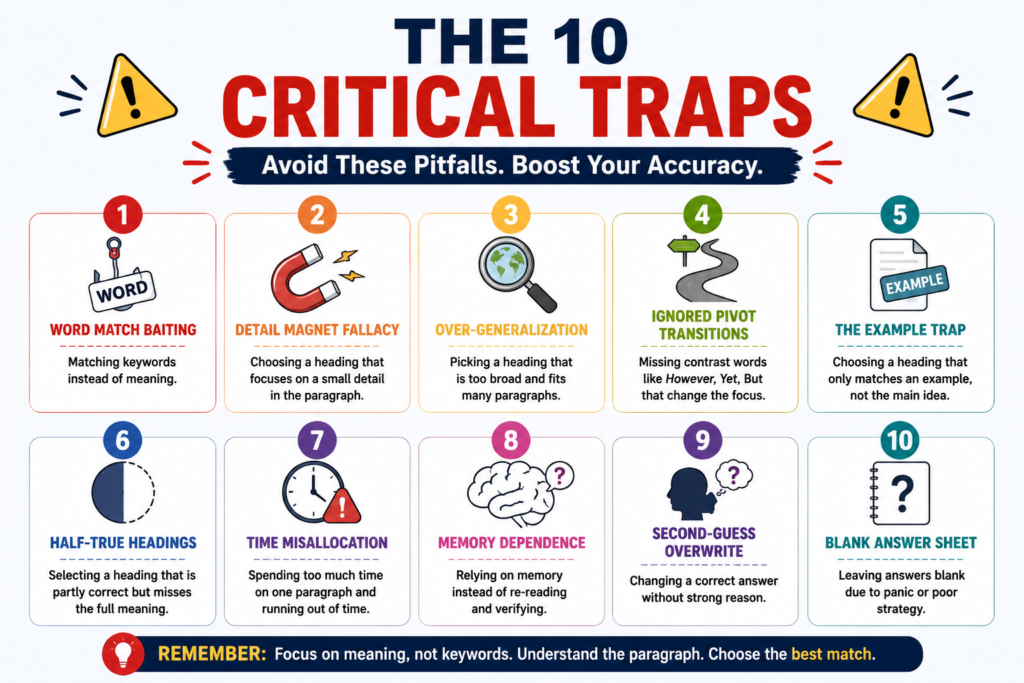
- Word Match Baiting: Choosing a heading because it contains the exact word from the paragraph.
- Fix: Look for conceptual synonyms, not matching letters.
- Detail Magnet Fallacy: Selecting a heading that describes an interesting stat or quote rather than the overall point.
- Fix: Ask, “Does this cover the whole paragraph or just one line?”
- Over-Generalization: Choosing a heading that is too broad and covers more than what the paragraph actually discusses.
- Fix: Ensure all specific limits in the heading match the text bounds.
- Ignored Pivot Transitions: Missing contrast words like However or On the other hand that completely flip the topic.
- Fix: Always circle transition words during your structural skim.
- The Example Trap: Falling for a heading that summarizes a side example introduced by “For instance…”
- Fix: Ignore sentences starting with illustration phrases when finding main ideas.
- Half-True Headings: Selecting a heading where the first half is correct, but the second half contradicts the text.
- Fix: Validate every single word in the chosen heading before committing.
- Time Misallocation: Spending 5+ minutes stuck on a single confusing paragraph.
- Fix: Write down two possible heading numbers, skip it, and return after solving easier paragraphs.
- Memory Dependence: Answering based on what you think you remember reading rather than re-verifying structure.
- Fix: Always keep your eyes on the paper and check structural markers.
- Second-Guess Overwrite: Changing correct answers at the last second out of panic.
- Fix: Stick to your 6-Step Blueprint unless you find clear proof of an error.
- Blank Answer Sheet: Leaving questions un-answered as time expires.
- Fix: IELTS has no negative marking—never leave a blank on your answer sheet!
SECTION 8: PRACTICAL WORKSHOP & SELF-ASSESSMENT
Now it is your turn to apply the blueprint independently. Read the following complete reading passage and match the headings. Detailed explanations and an answer key follow the passage.
PRACTICE PASSAGE: The Cognitive Psychology of Deep Reading
- Time Allowed: 10 Minutes
- Task: Choose the correct heading for Paragraphs A–F from the list below.
📋 List of Headings
- i. The physiological shift in brain wiring caused by digital skimming
- ii. Potential solutions for re-cultivating sustained attention in children
- iii. Historical resistance to newly introduced literacy mediums
- iv. The evolutionary origin of human reading capabilities
- v. How multi-tasking enhances information processing speed
- vi. The loss of critical and empathetic engagement through rapid reading
- vii. A comparison between audiobooks and traditional print media
- viii. The neurological mechanisms behind structural brain adaptability
- ix. Long-term societal risks of a declining deep-reading capacity
Text
Paragraph A
Unlike human speech, which is a natural biological capability wired into our species over hundreds of thousands of years through genetic evolution, reading is a completely artificial invention. Human beings were never born to read. There are no specific genes dedicated exclusively to literacy. To process written text, the human brain must construct an entirely new circuit by repurposing older neural structures originally designed for visual object recognition and spoken language comprehension. This capacity of the brain to reorganize its physical architecture in response to environmental demands is known in neuroscience as neuroplasticity.
Paragraph B
Because reading is a neuroplastic adaptation, the nature of the medium we use to read directly dictates which neural circuits are formed and strengthened. When reading immersive print books, the brain builds complex, highly interconnected pathways that support what cognitive scientists call “deep reading.” This process involves slow, linear decoding, deep critical analysis, inferential reasoning, and empathetic engagement with the narrative. In print reading, the eye moves at a deliberate pace, giving the prefrontal cortex adequate time to evaluate arguments, draw logical connections, and reflect on underlying emotional nuances.
Paragraph C
However, as human reading habits shift rapidly from physical print to screen-based digital media, our neural architecture is changing accordingly. Digital environments are purposefully designed to encourage rapid scanning, key-word spotting, and superficial skimming. The constant presence of hyperlinks, pop-up notifications, and scrolling feeds trains the brain to seek novel stimuli rather than sustained focus. Consequently, the dense, interconnected neural pathways required for deep reading begin to atrophy through disuse, replaced by short-circuit pathways optimized for quick processing of fragmented information.
Paragraph D
This neurological shift has profound consequences for critical thought. When readers skim text at high speeds, they miss subtle linguistic cues, rhetorical nuances, and underlying logical fallacies. More alarmingly, researchers have observed a measurable drop in reader empathy when complex narratives are read on screens. Deep reading allows individuals to step inside the mind of another person, fostering emotional intelligence and social cohesion. When reading degenerates into mere information extraction, our capacity to understand complex human experiences and evaluate multi-faceted political arguments is severely compromised.
Paragraph E
It is worth noting that societal anxiety over changing reading habits is not entirely novel. When the ancient Greeks transitioned from oral traditions to written text, the philosopher Socrates famously lamented that writing would destroy human memory and create a false illusion of wisdom. Centuries later, the invention of the Gutenberg printing press raised widespread fears that an abundance of cheap books would induce mental laziness and moral decay. While these historical panics proved largely overstated, modern neuroscientists insist that today’s digital transition is fundamentally different due to the unprecedented speed and addictiveness of digital media.
Paragraph F
If we allow deep reading to fade entirely, the ultimate casualty will be the health of our democratic institutions. A populace accustomed only to brief, sensationalist snippets of text becomes uniquely vulnerable to demagoguery, fake news, and simplistic political slogans. Complex societal challenges—such as climate change, economic inequality, and geopolitical conflicts—cannot be comprehended or solved through 280-character soundbites. Preserving our collective capacity for deep, sustained reading is therefore not merely an aesthetic preference, but a vital defense mechanism for maintaining a thoughtful, informed, and democratic society.
ANSWER KEY & DETAILED EXPLANATION MANUAL
Paragraph A = iv
- Text Analysis: Focuses on human evolution—contrasting natural speech (wired into our species over hundreds of thousands of years) with reading (an artificial invention). Explains that humans were never born to read and have no specific genes for it.
- Matching: Matches heading iv (The evolutionary origin of human reading capabilities).
- Distractor Rejection: Heading viii mentions neuroplasticity (which appears at the very end of Paragraph A), but Paragraph A’s primary purpose is establishing the evolutionary origin of reading, whereas Paragraph B explores the neurological details.
Paragraph B = viii
- Text Analysis: Explains how neuroplastic adaptation works during print reading. Details the creation of “complex, highly interconnected pathways” and how the prefrontal cortex processes deep reading.
- Matching: Matches heading viii (The neurological mechanisms behind structural brain adaptability). “Structural brain adaptability” is a direct paraphrase of neuroplastic adaptation.
Paragraph C = i
- Text Analysis: Transitions (However…) from print to digital media. Explains how scanning and scrolling cause neural pathways for deep reading to atrophy and be replaced by short-circuit pathways.
- Matching: Matches heading i (The physiological shift in brain wiring caused by digital skimming). “Brain wiring” = neural architecture/pathways; “physiological shift” = atrophy/re-wiring.
- Distractor Rejection: Heading v (How multi-tasking enhances information processing speed) is a trap. The text mentions quick processing, but frames it as a loss of depth, not an enhancement.
Paragraph D = vi
- Text Analysis: Focuses on the loss of two specific faculties: critical thought (miss subtle cues, rhetorical nuances, logical fallacies) and empathy (drop in reader empathy, capacity to understand complex human experiences compromised).
- Matching: Matches heading vi (The loss of critical and empathetic engagement through rapid reading). The heading perfectly captures both key concepts presented in the text.
Paragraph E = iii
- Text Analysis: Provides historical examples: Socrates opposing the invention of writing, and later fears about the Gutenberg printing press.
- Matching: Matches heading iii (Historical resistance to newly introduced literacy mediums). “Historical resistance” = Socrates lamenting / widespread fears about the printing press.
Paragraph F = ix
- Text Analysis: Discusses broad, long-term societal consequences: damage to democratic institutions, vulnerability to demagoguery, and inability to solve complex societal challenges.
- Matching: Matches heading ix (Long-term societal risks of a declining deep-reading capacity). “Societal risks” = health of democratic institutions / vulnerability to fake news.
SECTION 9: TIME MANAGEMENT & TEST-DAY EXECUTION
To complete the IELTS Reading module within the strict 60-minute time limit, you must manage your time with military precision.
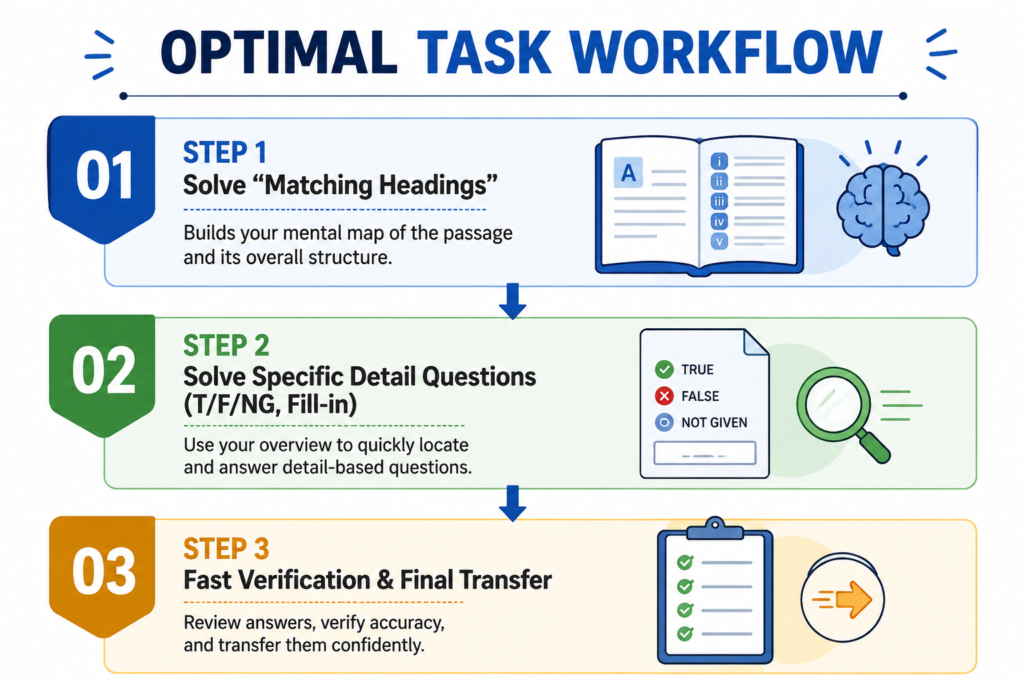
9.1 Strategic Question Ordering
PRO STRATEGY: Always solve “Matching Headings” questions FIRST within a passage set!
Because Matching Headings forces you to read the entire passage structurally, solving it first builds a complete mental map of the text. When you move to subsequent questions (True/False/Not Given, Sentence Completion, or Diagram Labelling), you will instantly know exact paragraph locations for specific information!
SECTION 10: PRINTABLE MASTER SUMMARY CHECKLIST
Keep this summary checklist in your study binder for quick review before practice tests!
- [ ] Cross out used examples from both the headings list and paragraph text immediately.
- [ ] Deconstruct headings into “What” (Topic) and “So What?” (Qualifier).
- [ ] Never match exact words—always look for synonyms, concepts, and paraphrases.
- [ ] Identify the Topic Sentence: Check start (60%), end (25%), or after a pivot (15%).
- [ ] Formulate a 3–5 word “Mini-Gist” in the margin before looking at options.
- [ ] Watch out for Detail Traps: Ensure the heading covers the Container, not just one Fruit.
- [ ] Circle transition signals (However, As a result, Ultimately) while skimming.
- [ ] If stuck between two choices, write down both options and move forward—return when fewer headings remain.
- [ ] Cross off headings cleanly as you assign them to prevent cognitive overload.
- [ ] Use Matching Headings as your roadmap to answer remaining passage questions in record time!
Related posts:
 IELTS Reading True False Not Given: The Ultimate Guide to Getting More Answers Right
 IELTS Reading Masterclass :”Why Pakistani Students Fail IELTS Reading (And The 60-Minute System to Hit Band 8+)”
 Formal vs. Informal English from an IELTS Perspective : Master Class
 Formal vs Informal English for IELTS Academic Writing WorkSheet :