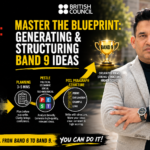
Generating high-level, relevant ideas on the spot is one of the biggest hurdles in IELTS Writing Task 2. Many candidates freeze or write generic, repetitive essays because they lack a systematic approach to idea generation and organization.
Here is a comprehensive guide to expanding your mindset, organizing your thoughts, and applying them directly to achieve a Band 9 score.
Part 1: How to “Grow” Your Brain for Instant Idea Generation
To generate Band 9 ideas under exam conditions, you don’t need expert-level knowledge in every field—you need structured thinking frameworks.
1. The PESTLE Framework
When faced with a broad prompt, analyze the topic through these six lenses:
- Political (Laws, government policies, international relations)
- Economic (Cost, business, employment, taxation)
- Social (Culture, family, lifestyle, public perception)
- Technological (Automation, internet, efficiency, innovation)
- Legal (Regulations, consumer rights, crime prevention)
- Environmental (Pollution, sustainability, resource management)
Example Prompt:
“Should governments make public transport free for everyone?”
- Economic: Increases tax burden on working citizens, but reduces traffic congestion costs.
- Social: Improves mobility for low-income families and equalizes access to education/jobs.
- Environmental: Decreases individual car emissions, lowering urban air pollution.
2. The Micro vs. Macro Perspective
If you run out of ideas, shift your viewpoint between individuals and society as a whole.
- Micro (Individual Level): How does this affect mental health, daily convenience, personal finance, or personal freedom?
- Macro (Societal/Global Level): How does this affect national economies, cultural norms, global public health, or global trade?
3. The “Why & So What?” Method
Avoid listing ideas without depth. Expand every core idea by asking “Why?” and “So what?” twice:
- Idea: Plastic packaging should be banned.
- Why? —————Single-use plastic takes hundreds of years to decompose.
- So what? —————It fills landfills and enters marine ecosystems.
- So what? —————Microplastics contaminate the human food chain and harm biodiversity.
Part 2: How to Organize Your Ideas Efficiently
Spent no more than 3 to 5 minutes planning before writing. A disorganized essay caps your Task Response and Coherence & Cohesion scores at Band 6.
The 4-Paragraph Band 9 Blueprint
- Introduction:
- Paraphrase the prompt.
- Thesis statement (Direct position + outline of main reasons).
- Body Paragraph 1 (First Main Idea):
- Topic Sentence: Clear main point.
- Explanation: Elaborate on why or how (2–3 sentences).
- Example/Result: Specific supporting evidence or logical outcome.
- Body Paragraph 2 (Second Main Idea):
- Topic Sentence: Clear main point (or counter-argument + refutation).
- Explanation: Elaborate on why or how (2–3 sentences).
- Example/Result: Specific supporting evidence or logical outcome.
- Conclusion:
- Restate thesis statement using varied vocabulary.
- Summarize key points (No new ideas!).
Part 3: Writing and Applying Ideas to the IELTS Pattern
To score Band 9, your ideas must be developed logically. Avoid superficial lists of arguments; focus on depth over quantity. One well-developed idea per body paragraph is often superior to three underdeveloped points.
Idea Development Formula: PEEL
- Point (State the main argument)
- Explanation (Explain the underlying cause or mechanism)
- Example (Provide a realistic illustration)
- Link (Connect back to the prompt/thesis)
Part 4: Band 9 Model Essay
Prompt:
“Some people believe that university education should be free for everyone, while others think that students should pay for their higher education. Discuss both views and give your opinion.”
Essay Structure & Breakdown
Introduction
Higher education plays a pivotal role in personal career advancement and national economic prosperity. While some argue that tertiary education should be funded entirely by the state to promote social equality, others contend that personal financial investment ensures commitment and relieves public budgets. In my view, while state subsidies(aids) are beneficial, a hybrid system with subsidized tuition based on merit and financial need is the most sustainable solution.
Body Paragraph 1: Free University Education (Social & Economic Perspective)
Proponents of tuition-free higher education argue that it democratizes learning and drives economic progress. When universities are accessible without financial barriers, talented individuals from lower socio-economic backgrounds can acquire specialized skills without taking on heavy debt. Consequently, this expands the skilled workforce in crucial sectors such as medicine, engineering, and technology, ultimately boosting national productivity and tax revenue. For instance, countries like Germany offer tuition-free public universities, which has directly contributed to high innovation rates and a strong, highly qualified workforce.
Body Paragraph 2: Paid University Education (Fiscal(financial) Responsibility & Quality)
Conversely, advocates for self-funded education maintain that charging tuition fees maintains educational standards and prevents excessive tax burden on the public. Running modern universities requires substantial capital for state-of-the-art research laboratories, high-calibre faculty, and advanced digital infrastructure. If governments bear the entire financial burden, public resources may be overstretched, potentially compromising the quality of facilities and instruction. Furthermore, when students contribute financially to their degrees, they are often more motivated to complete their studies efficiently, reducing dropout rates.
Conclusion
In conclusion, while free higher education promotes equal opportunity and enhances human capital, state funding alone can strain(stress) public finances and compromise educational standards. Therefore, governments should implement targeted financial aid and merit-based scholarships rather than universal free tuition, balancing accessibility with economic sustainability.
Key Vocabulary & Cohesion Breakdown
| Feature | Band 9 Implementation in Sample |
| Topic-Specific Lexicon | tertiary education, socio-economic backgrounds, human capital, merit-based scholarships, overstretched resources |
| Cohesive Devices | Consequently, For instance, Conversely, Furthermore, In conclusion |
| Grammatical Range | Advanced conditional structures, complex complex-compound sentences, and passive constructions (“When universities are accessible…”, “If governments bear…”). |

Legendary trainer in Faisalabad the one and only, Ali Imaran